You will be naked and alone in an unfamiliar room where you will be massaged by a blind Chinese man, whose level of visual imparity is questionable. This was one of the various impressions I was given about the famed “Blind Massage.” After arriving in China, I immediately began to investigate where to go for a cheap massage. In case there’s any confusion about a westerner looking for a cheap massage in Asia, I mean the kind that’s needed to repair your body after 30 hours of traveling.
Shortly after beginning my quest, I was informed of the blind massage, preformed by a blind person, whose visual disability supposedly translates into heightened massaging ability. With my current Mandarin deficiency, I have enough trouble ordering meals, so the prospects were slim for finding out exactly what a blind massage would entail. Instead, I had to rely on the well intentioned, but incredibly confusing and conflicting accounts from Chinese English speakers of various skill levels. For example, one of these accounts was described in the opening sentence of this story. So, on the scheduled day of this event, I was ambivalent, to say the least.
We headed out in a party of 3, consisting of El Pro, (aka LP), Guen, (a fellow American English teacher), and Penny, our assistant/ translator/ mandarin instructor. The Americans agreed to wait down the block, while Penny inquired about the actual cost of the massage, versus the foreigner cost we would likely be quoted otherwise. Before parting at the corner, Penny left us with the encouraging last words; “He can see something, so be careful.” This was comprehended as; "He may not be fully blind, so don’t take off your shirt in front of him."
So, we reluctantly enter the premises, where several seemingly visually impaired Chinese people are milling around, and quickly led into a side room with 3 bamboo massage tables. Shortly after, 2 blind Chinese men enter the room, followed by a blind Chinese woman who feels her way towards my table and locates me by palming my scalp. She commences her massage, which initially consists of her rocking my body back and forth across the bamboo mattress. At this point, I begin to wonder if I’ve just become the latest victim of a con that gets pulled on every naive foreigner who comes to China. Eventually, she finds her groove and starts to relax my muscles and my paranoia. The next 40 minutes are the most relaxing I’ve had in China, and she even throws in a few chiropractic maneuvers along the way. When it was all said and done, it wasn't the best massage I’ve ever had, probably not even in the top 50. Still, its something I’m unlikely to forget anytime soon, and a bargain at 35 quai , or about $5.
Monday, September 15, 2008

Sunday, September 7, 2008
"You are so very busy."
Now, for the life of a lao shi (teacher). First, let me elaborate on my living conditions. I'm living in what is basically a deluxe dorm room, in the same building as some of my actual students at the Huzhou New Century Foreign Language Primary School. For some background, Chinese people, and Chinese students in particular, work HARD. They go to school from 7am to 7pm, and those whose parents are wealthy enough and/or too busy to take care of them, send them to private schools, such as New Century, where the kids sleep on campus Sunday night through Friday evening.
My "apartment," features a microwave and a mini-fridge for a kitchen, which means that my meals have mostly been in the school cafeteria, which is free, but also free of any variety. The weekly menu is mostly made up of different variations of pork and rice, such as pork nuggets with pig sauce over rice, or rice with pork bits over bacon. Meanwhile, above the service counter, illusory images of fresh fruits and vegetables taunt the diners. Thankfully, one benefit of globalization is that I was able to find peanut butter in the local supermarket, which has helped me coat my stomach for the swine-ification of my diet. My bathroom consists of a squat toilet and a pipe emerging from the wall (the shower), both being contained within a 3' x 3' cell. On the bright side, every time I take a shower, I'm simultaneously cleaning the toilet!
By Chinese standards, my living situation is glamorous for a teacher. The Chinese teachers on campus actually share the same room that I have between two people, only with no computer, T.V., or air conditioning. My initial response to the location of my living quarters was the general awkwardness of living down the hall from my 12 year old pupils. This uneasiness has since come into fruition in the form of door bell ditch, which has conditioned me to never answer the door when I'm not expecting company. The biggest downfall so far is the random stampedes of kids who come barreling down the stairs in various waves between 6-9pm , when they're finally done with their days work. Headphones are able to drown out the noise of these herd migrations, but unable to keep the building from shaking.
I have absolutely no teaching experience, and as previously mentioned, very little formal training. So, you can imagine my response when I found out I would be teaching 225 students per week, in 7 different classes, ranging from grades 6-10. "Bu yao!" My favorite new phrase, which means "I don't want to," and sounds exactly how it looks.
Turns out, the students are mostly ideal language sponges. It's just unfortunate that their energy isn't constantly harnessed for productive learning. At the risk of losing some American masculinity points, I'll go ahead and say that Chinese kids, (before they reach the universal, grunting, indifference to the world age of high school), are adorable. They can then be further broken down into three sub-categories; the shy ones who avoid eye contact and cover their mouths when they speak, the out-going ones who raise their little T-Rex limbs as high as possible in any question answering opportunity, and then the ones who have some kind of energy imbalance and have continual outbursts of screaming and flailing limbs. The most difficult day of my week is Wednesday, when I have to catch the 7am bus to get to the high school, teach 2 classes of tenth grade, followed by one 9th grade class, then take the bus back to the primary school campus where I get to wind down in the afternoon with back to back classes of 42 6th graders, who for lack of a better word, are crazy. Hopefully, teaching 16 year-old's how to ask for directions to the bank, on the same day that I teach 11 year old's how to say "nice to meet you," won't turn me into a schizophrenic. In looking at what you could say is the tin lining of the situation, there's no shortage of enthusiasm in the younger students. A big hit in all of my classes was showing the students pictures of my family and friends, which caused so much commotion that they literally ripped one of the photos while fighting over who could look at it first. (Sorry Mom, it was a picture of you). It's nice that there's never a shortage of volunteers to read out loud in front of the class, but the trade off is that their enthusiasm knows no bounds. They're equally enthusiastic about rolling around on the ground and chest bumping each other whenever its time to stand up for a game of telephone. Contrast this with the tenth graders who would be perfectly content to sleep through every waking minute of the day, and you have a recipe for very difficult lesson planning. Every day when I leave the high school, my colleague, previously mentioned in the ganbei showdown, looks at me with a look of utter despair and says "Oh, you are so very busy," to which I can only nod my head, and say, "Yes, I am."
This is by far the most challenging job I've ever undertaken, and combined with trying to learn functional Mandarin I will be "so very busy" for the remainder of 2008.
My "apartment," features a microwave and a mini-fridge for a kitchen, which means that my meals have mostly been in the school cafeteria, which is free, but also free of any variety. The weekly menu is mostly made up of different variations of pork and rice, such as pork nuggets with pig sauce over rice, or rice with pork bits over bacon. Meanwhile, above the service counter, illusory images of fresh fruits and vegetables taunt the diners. Thankfully, one benefit of globalization is that I was able to find peanut butter in the local supermarket, which has helped me coat my stomach for the swine-ification of my diet. My bathroom consists of a squat toilet and a pipe emerging from the wall (the shower), both being contained within a 3' x 3' cell. On the bright side, every time I take a shower, I'm simultaneously cleaning the toilet!

By Chinese standards, my living situation is glamorous for a teacher. The Chinese teachers on campus actually share the same room that I have between two people, only with no computer, T.V., or air conditioning. My initial response to the location of my living quarters was the general awkwardness of living down the hall from my 12 year old pupils. This uneasiness has since come into fruition in the form of door bell ditch, which has conditioned me to never answer the door when I'm not expecting company. The biggest downfall so far is the random stampedes of kids who come barreling down the stairs in various waves between 6-9pm , when they're finally done with their days work. Headphones are able to drown out the noise of these herd migrations, but unable to keep the building from shaking.
I have absolutely no teaching experience, and as previously mentioned, very little formal training. So, you can imagine my response when I found out I would be teaching 225 students per week, in 7 different classes, ranging from grades 6-10. "Bu yao!" My favorite new phrase, which means "I don't want to," and sounds exactly how it looks.
Turns out, the students are mostly ideal language sponges. It's just unfortunate that their energy isn't constantly harnessed for productive learning. At the risk of losing some American masculinity points, I'll go ahead and say that Chinese kids, (before they reach the universal, grunting, indifference to the world age of high school), are adorable. They can then be further broken down into three sub-categories; the shy ones who avoid eye contact and cover their mouths when they speak, the out-going ones who raise their little T-Rex limbs as high as possible in any question answering opportunity, and then the ones who have some kind of energy imbalance and have continual outbursts of screaming and flailing limbs. The most difficult day of my week is Wednesday, when I have to catch the 7am bus to get to the high school, teach 2 classes of tenth grade, followed by one 9th grade class, then take the bus back to the primary school campus where I get to wind down in the afternoon with back to back classes of 42 6th graders, who for lack of a better word, are crazy. Hopefully, teaching 16 year-old's how to ask for directions to the bank, on the same day that I teach 11 year old's how to say "nice to meet you," won't turn me into a schizophrenic. In looking at what you could say is the tin lining of the situation, there's no shortage of enthusiasm in the younger students. A big hit in all of my classes was showing the students pictures of my family and friends, which caused so much commotion that they literally ripped one of the photos while fighting over who could look at it first. (Sorry Mom, it was a picture of you). It's nice that there's never a shortage of volunteers to read out loud in front of the class, but the trade off is that their enthusiasm knows no bounds. They're equally enthusiastic about rolling around on the ground and chest bumping each other whenever its time to stand up for a game of telephone. Contrast this with the tenth graders who would be perfectly content to sleep through every waking minute of the day, and you have a recipe for very difficult lesson planning. Every day when I leave the high school, my colleague, previously mentioned in the ganbei showdown, looks at me with a look of utter despair and says "Oh, you are so very busy," to which I can only nod my head, and say, "Yes, I am."
This is by far the most challenging job I've ever undertaken, and combined with trying to learn functional Mandarin I will be "so very busy" for the remainder of 2008.
Wednesday, September 3, 2008
Gone bay, bye Joe.
My stay in Dalian ended dramatically, thanks to "ganbei" and baijiu. "Ganbei" is Chinese for "cheers", only it's a much more serious proposition than a toast. When someone salutes you with a full glass and a "ganbei!" you're politely expected to consume the contents of your glass, or risk offending the inviting party. Baijiu is a 120 proof wonder potion that probably has many useful applications other than human consumption. Combine a few ganbeis and biejius and a bastard child of intoxication will soon be birthed. Fortunately, I managed to limit myself mostly to ganbei and pijiu (beer) collisions. Still, it was enough to make for a not so pleasant 800 mile flight South to Huzhou, my home for the next 4 months. Greeting me at my arrival dinner were 4 ganbei trigger happy women, representing my various schools to be. Luckily, this was a putaojiu (wine) party rather than a biejiu party, so I did my best not to offend anyone by participating in every requested ganbei. By the end of the night, I was initiating the ganbeis, to show my respect, and I ended up in a showdown with the lead teacher of the group. She protested that her glass was too full, at which point I offered that she only drink half. After we drank our respective half and full glasses, I overheard one woman whispering to another, "He is true gentleman."
As a disclaimer, I have only experienced a sliver of life in China, so anything I say is not a blanket statement. That being said, nearly every one of my personal daily interactions has been an unorganized, bureaucratic maze of confusion. Chalk some of it up to the language barrier, but I'm starting to get the impression that people are just acclimated to constant chaos. I already have enough examples of head-scratching moments to write volumes, but I'll illustrate my point with one shining specimen. When we arrived in Huzhou, one of my fellow teachers arrived at his assigned apartment and was greeted by an angry Chinese woman who was still living there, while preparing to move all of her worldly possessions down four narrow flights of stairs. The following night we had a gathering at his apartment, which was interrupted by the same angry woman, who burst into his bedroom to grab her bras that were drying in the window, while yelling a continuous chain of what is safe to assume was profanity. We found ourselves congregated in his kitchen, along with the angry woman, the landlady, and the next door neighbor. Since, none of us speak any Putonghua (Mandarin), all we were able to take away from the encounter, through body language, was that the next door neighbor wanted us to give free English lessons to her son, and the furious former tenant would be sharing the apartment with us for the night. The latter did take place, but without any drama, as the landlady seemed to have calmed her down. It seems that there's never any organized plan, and things are expected to haphazardly unfold, somehow for the better. So far, they eventually have, but probably more so than any other place I've been, China requires a sense of humor of epic proportions. To be perfectly clear, these frustrations are more observations of an outsider than complaints. Most of the people I've met have been incredibly helpful, and besides, a few misunderstandings don't even come close to counteracting the thrill of paying 45 cents for a pair of sandals. Not to mention, $5 for a 1 hour full-body massage, to be explained at a later date.
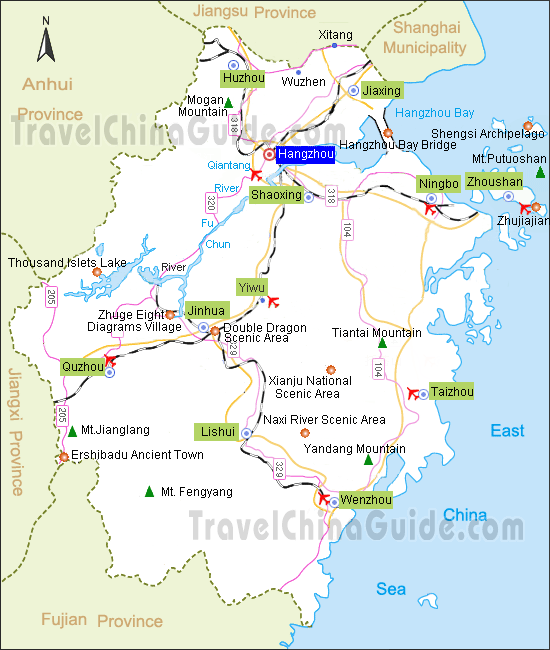
To briefly describe my new home, Huzhou is located in the Northern Zhejiang province, where there are guesstimated to be a total of 30 foreigners, including Mr. Lucky Promise. This means double takes galore, as people take a second or third look, or in most cases just one long continuous stare, at the rare sight of a non-Chinese person cruising down the block. (People are not surprised when I tell them I'm half Chinese, usually pointing to their eyes as the give away. Still, they can't seem to comprehend how I'm unable to speak any Putonghua, as if mastery of the language is built into my DNA, waiting to emerge once I step foot in the homeland.) Anyways, as uncomfortable as the non-stop gawking might sound, people are usually friendly, some bursting into laughter, and others offering up whatever English words they know, usually "hello," or if you're lucky, "I love you." The city has a population of about 1 million, which is small by Chinese standards. It's roughly the physical size of Oakland, but with the feel of a safe small town. One exception to this feeling is the fact that the streets are littered with what I've come to refer to as 'silent assassins', or electric scooters, silently zipping through every available square centimeter of pavement in the city, sidewalks included. Ive already been clipped by the side view mirror of one of these little vehicles of mayhem, and I live in constant fear of having my toes run over with no audible forewarning.
One of the most entertaining aspects of life in China is attempting to make sense of the most random possible combination's of English words and phrases that seem to appear on just about every article of clothing. For example, "Run if you see my gun," "bad boy girls," or my personal favorite, "Too young to be born." I assume the inverse must be true, and clothing in the U.S. with Chinese characters features equally ridiculous combination's of words that just cant be translated correctly. More importantly, I wonder about all those non-Chinese speaking people who get tattoos of Chinese characters, while not being entirely certain of the exact meaning. And you thought that you were showing the world you're a Pisces.
As a disclaimer, I have only experienced a sliver of life in China, so anything I say is not a blanket statement. That being said, nearly every one of my personal daily interactions has been an unorganized, bureaucratic maze of confusion. Chalk some of it up to the language barrier, but I'm starting to get the impression that people are just acclimated to constant chaos. I already have enough examples of head-scratching moments to write volumes, but I'll illustrate my point with one shining specimen. When we arrived in Huzhou, one of my fellow teachers arrived at his assigned apartment and was greeted by an angry Chinese woman who was still living there, while preparing to move all of her worldly possessions down four narrow flights of stairs. The following night we had a gathering at his apartment, which was interrupted by the same angry woman, who burst into his bedroom to grab her bras that were drying in the window, while yelling a continuous chain of what is safe to assume was profanity. We found ourselves congregated in his kitchen, along with the angry woman, the landlady, and the next door neighbor. Since, none of us speak any Putonghua (Mandarin), all we were able to take away from the encounter, through body language, was that the next door neighbor wanted us to give free English lessons to her son, and the furious former tenant would be sharing the apartment with us for the night. The latter did take place, but without any drama, as the landlady seemed to have calmed her down. It seems that there's never any organized plan, and things are expected to haphazardly unfold, somehow for the better. So far, they eventually have, but probably more so than any other place I've been, China requires a sense of humor of epic proportions. To be perfectly clear, these frustrations are more observations of an outsider than complaints. Most of the people I've met have been incredibly helpful, and besides, a few misunderstandings don't even come close to counteracting the thrill of paying 45 cents for a pair of sandals.
 Not to mention, $5 for a 1 hour full-body massage, to be explained at a later date.
To briefly describe my new home, Huzhou is located in the Northern Zhejiang province, where there are guesstimated to be a total of 30 foreigners, including Mr. Lucky Promise. This means double takes galore, as people take a second or third look, or in most cases just one long continuous stare, at the rare sight of a non-Chinese person cruising down the block. (People are not surprised when I tell them I'm half Chinese, usually pointing to their eyes as the give away. Still, they can't seem to comprehend how I'm unable to speak any Putonghua, as if mastery of the language is built into my DNA, waiting to emerge once I step foot in the homeland.) Anyways, as uncomfortable as the non-stop gawking might sound, people are usually friendly, some bursting into laughter, and others offering up whatever English words they know, usually "hello," or if you're lucky, "I love you." The city has a population of about 1 million, which is small by Chinese standards. It's roughly the physical size of Oakland, but with the feel of a safe small town. One exception to this feeling is the fact that the streets are littered with what I've come to refer to as 'silent assassins', or electric scooters, silently zipping through every available square centimeter of pavement in the city, sidewalks included. Ive already been clipped by the side view mirror of one of these little vehicles of mayhem, and I live in constant fear of having my toes run over with no audible forewarning.

One of the most entertaining aspects of life in China is attempting to make sense of the most random possible combination's of English words and phrases that seem to appear on just about every article of clothing. For example, "Run if you see my gun," "bad boy girls," or my personal favorite, "Too young to be born." I assume the inverse must be true, and clothing in the U.S. with Chinese characters features equally ridiculous combination's of words that just cant be translated correctly. More importantly, I wonder about all those non-Chinese speaking people who get tattoos of Chinese characters, while not being entirely certain of the exact meaning. And you thought that you were showing the world you're a Pisces.
Monday, September 1, 2008
"Janky", for lack of a better word.

Taking off from SFO was like being launched out of a canon, and looking back at the insulated bubble known as "The Bay," in which I had previously resided for the last 2 years. Arriving in China was like being back-handed by Yao Ming, and not knowing whether to be deeply offended or appreciative. My initiation to the motherland occurred in Incheon International Airport in Seoul, South Korea, where I spent 20 hours sleeping on benches and trying to learn 2 months worth of Mandarin. At the ungodly hour of 6:00 AM, I awoke to what sounded like a communist marching band blaring through the loud speakers, followed by the entirely female staff of Asiana Airlines engaging in a collective bow, signaling the opening of the check-in counter. Two hours later, I took my first step onto Chinese soil in the city of Dalian, which is larger than Chicago.
I was whisked away to the office of my teaching company by Ed, the only American employee in the administrative branch of my program. Navigating the streets of downtown Dalian in a jet-lagged stupor is where I received my metaphorical back-hand. The smells and sounds of the street race into your orifices in a competition to see which sense will provoke your legs to move faster towards your destination.
 Day two began with what is sure to be the first of many "China Moments," as I was sent to a Chinese hospital to get a health clearance to participate in the teaching program. To ease my worries about going through with the ordeal, Ed explained that Chinese hospitals are "janky, for lack of a better word." Supposedly, I was being sent to the least jankiest hospital in town. Once I arrived at this quality establishment, I underwent a battery of tests, the most notable being my first ever ultrasound. Despite the profound confusion this caused, it's nice to know for sure that I'm not carrying a child.
The same day, I was taken to the local police station to receive a residence permit, as well as the inspiration for the name of this blog's website. To complete my application, the police needed my non-existing Chinese name, so by default, I was given the closest sounding, most prosperous name they could think of, or Ji Nuo, which translates as "Lucky Promise." Please, feel free to make any jokes that this inspires in your imagination.
The majority of my first week was spent training with other equally inexperienced teachers in preparation for a teaching job of monumental proportions, which will be explained later. The take home message from these sessions, which were led by a Canadian named Rick, was along the lines of; "There may be up to fifty kids in each class, and they may consist of students at every possible level on the spectrum of language skills, but relax, and have fun with them!" Week one also contained several seemingly inconsequential, but unbelievably satisfying moments like successfully ordering food in a restaurant that didn't have pictures of the food, and participating in a pick-up game of basketball with 12 year old Chinese kids. Small victories must be celebrated.
Obviously, China is a crowded place, but there is absolutely no way to comprehend the magnitude of this statement until you've been in a Chinese elevator. The typical experience consists of three steps. First, waiting until the mass of people ahead of you gets on an empty elevator, and positioning yourself for the next one that's available. (People's eyes usually gloss over in a fierce, determined stare during this stage.) Then, fighting your way into any available crevice when the doors open, and managing not to get violently slapped by the all-too-qwickly-closing elevator doors. And finally, stopping on literally every single floor between you and your desired destination, as more people attempt to join the party. Adventures arise out of trivial acts, like crossing the street, which is viewed by both Chinese motorists and pedestrians as a real life version of Frogger. So far, China is everything I imagined it might be, unlike anything I have ever experienced, which is exactly what I was looking for. Stay tuned for the life of an Engrish teacher.
Subscribe to:
Posts (Atom)


 Posts
Posts

