Monday, November 3, 2008

Havings of good times.

When it’s time to unwind and enjoy yourself in China, you will likely be presented with a fork in the road leading in two seemingly opposing directions. Even if there are no legible signs posted, your intuition will inform you that your duo of choices are singing karaoke or drinking tea. Whether you’re in the middle of a crowded downtown intersection, or wandering through a dark alley, you’ll never be far from a KTV (karaoke), or a chaguan (teahouse). The former will be desperately attempting to grab your attention from 5 blocks away with a neon light show engineered to deliver you into a mind altering seizure. The latter will calmly convince you of its worthiness, subtly pulling you in with soothing plants and tranquil fish tanks. The appeal of both venues, different as they may seem, lies in their distinguishing feature; a private room for you and your friends to entertain each other, usually in embarrassing ways that are better kept behind closed doors. Both are available at any desired level of quality, ranging from a soggy couch surrounded by four blank walls, to an elaborately designed suite that could be the set of an extravagant music video.

I would guess that the mutual success of KTV and the chaguan are owed to the traditional structure of the Chinese family. People generally live with their parents until they get married, so there is great appeal in having a private space to escape to. Maybe people are so infatuated with sipping tea and singing love songs that the opportunity to partake in either exists within any 1 block radius, but I think more likely is that they just want to get away from home for a few hours. I’m pretty sure a private room with an etch-a-sketch and a trampoline would be equally successful if marketed properly. I wouldn’t describe singing or drinking 'cha' as my ideal way of spending a Friday night, but in keeping with my pledge to follow through on the philosophy "When in China…," I’ve ended up in both of these settings on a more than a handful of occasions.

It seems that in the domain of KTV, every Chinese person reveals their secret identity as an aspiring vocalist. If you’re one of the unfortunate souls in China who can’t sing, you’ll likely be ostracized by your peers like a Brazilian who doesn’t know how to dance. On the surface, Chinese people may mislead you into assuming that they are reserved, but put a microphone in their hand and display a bootleg music video on a giant projection screen, and you’ll open up the floodgates to some serious outpouring of heart and soul. Since nobody managed to tell me that the Chinese are petitioning the International Olympic Committee to make karaoke an official event at the 2012 Olympics, (Not really, but they do take it very seriously), I managed to embarrass myself, and my country, by my making a complete mockery of every song I attempted to recreate. After butchering such musical masterpieces as ‘Hey Jude,’ and ‘Gangsta’s paradise,’ I witnessed my Chinese counterparts clear their throats and proceed to belt out a variety of ballads, showcasing their extraordinary vocal range. During a KTV birthday party for my assistant, Penny, my American co-stars and I noticed that the majority of the Chinese contingent seemed to flee the room whenever we were singing. This was justified as their being courteous enough to step outside of the room to smoke cigarettes, but I wonder if it was just to escape the ridiculous exhibition that was taking place inside.
My most notable experience at a chaguan took place with a Chinese coworker and her array of acquaintances, who invited Guen and me to join in a game of ‘Mafia,’ which involves imaginary murder.

So the scene is as follows; Guen and I form the southwest boundary of a circle of people who identify themselves by such English names as “Do, Shrek, Spirit hunter, Pear, House, Dream,” and our coworker “Coco.” All told, there are 14 people awkwardly squeezed into a room intended to accommodate 7. Spread before us on an ill-equipped coffee table, are the usual suspects in the world of Chinese snacks, including the typical watermelon, cantaloupe, and cherry tomato trifecta. Smothering almost every other available square inch of the table are sunflower seeds, cold chicken feet, peanuts, and random stringy substances amongst a variety of herbal infusions. In the audible background, Chinese music videos compete with the steady hum of the air conditioner.
For 3 hours, we participate in the psychological warfare that ‘Mafia’ demands, and I manage to learn and forget many new and interesting phrases like “He is the killer because he blinks too much when he talks.” By the time the fifth game comes to a close, the novelty of the situation begins to fade, and I enter a state of wonder as to how this group in their late twenties is still entertained by a game that I use as a reward for my tenth grade students when they’re on good behavior. Particularly intriguing is the absolute absence of alcohol from this gathering, other than the bottle of beer that I’ve smuggled into the premises. People have random, inexplicable outbursts of laughter that might usually be associated with intoxication, but there is nothing but herbal goodness being consumed at this party. Is it the synergy of foliage in hot water and mock violence that inspires such unadulterated amusement, or is it the universal appreciation for quality time spent with friends?

Thursday, October 23, 2008

Ni hao lao shi?

The halfway point of my teaching gig is fast approaching, which warrants an update on my trials and tribulations as an educator. I’m starting to adapt to life in the jungle, but it’s not necessarily getting easier. Never have I had a job where success is so intimately tied to preparation. The time I invest in assembling lessons directly correlates to whether or not I can create the illusion that I’m actually an experienced professional.

Also included in this equation is the quality, or lack thereof, of the textbooks I’ve been assigned to teach. The books I use for my 7th to 10th grade students are mostly useful, but the travashamockery of an educational device known as “New Concept English,” which I have been relegated to use with my 6 graders, should be cordially invited to a book burning party. It would be a disgrace even if it was written in the 1950’s, but unfortunately it was published as recently as 1997.

Tucked neatly amongst a surplus of Britishism laden lessons, such as “Sorry, sir” and “What make (car) is it?” are assortments of confusing, annoying, and offensive situations. For example, a few lessons feature an unusually busty French exchange student. I buried my shamed face in chalk encrusted hands on several occasions after subjecting my students to the audio tape featuring Sophie, and her equally ridiculous and inaccurate French accent.

“Ha eeh, mah eeh nay um eez Soh fee. Nigh us to meet yew.”

The list of grievances could proceed indefinitely, but several other egregious offenses come to mind. Actual quotes from the text, which are intended to be repeated by the students, include such gems as “Would you care for some whisky?” “How about a cigarette?” or “Let’s go have a drink. There’s a bar next to the station.” The epitome of the book’s message can be wrapped up in the following example. A lesson about opposites featured various images and captions, such as a dirty mechanic and a clean nurse. Corresponding with an image of a “busy hair dresser,” was a woman kicking back with her feat up, while a mountain of dirty dishes sits idly by the sink in the foreground. The caption is “lazy housewife.”

So, as the semester has progressed, I’ve shifted towards abandoning the book completely and creating my own lessons from scratch, which is far more time consuming, but less conscience crushing. The combination of terrible teaching materials and the inexhaustible energy of 12 year olds, who are trapped in the confines of the classroom from 7am to 7pm, make my 6th grade classes by far the most difficult.

Luckily, this age group has an incredibly long attention span when it comes to hangman. I’ve realized, in the thinking outside of the box which goes along with being in another country, hangman is a really strange and violent game to teach small children. Anyways, they love it, and wouldn’t mind if it consumed every available minute of class time. However, there is a growing league of saboteurs who are intent on seeing the helpless man perish, constantly guessing letters such as z, x, and q, followed by a chorus of giggles from fellow saboteurs when an appendage is added to our sacrificial stick man. So, you can imagine their disappointment when they accidentally succeeded in solving the word “crazy.”
Taming these swarms of “Bebe’s Kids” has taken a toll on my mental stability. Most folks find it hard to imagine me directing the energy of a large group of children, and rightfully so. My usual carefree attitude is incompatible with commanding a mass of ten-second attention spans. I’ve been able to step my game up, but it requires such a departure from my ordinary state of being that it completely drains my energy reserves. I’ve adapted my daily routine by including afternoon naps and occasional meditation to repair the resulting psychological dissonance (I guess that Psychology degree is finally paying off).

These kids do have one redeeming factor, which is the unconditional enthusiasm and adoration they express towards their lao shi. This is most often manifested in the incessant screaming of my name whenever they spot me on campus, which may be the easiest “Where’s Waldo?” the world has ever seen. Sometimes, they show hints of being wiser beyond their years, and they manage to reach me on a deeper level. In the lesson about opposites which featured the lazy housewife, I was able to at least teach them the difference between hot and cold, and clean versus dirty. As the lesson was winding down, I put myself in a vulnerable situation by asking several all or nothing questions, such as, “Am I fat or thin, tall or short, and most importantly, am I young or old?” I wasn’t really concerned about the first two, but given my recent realization about being almost a decade removed from high school, I had doubts about the potential responses to the final question. To my surprise, all 168 of the little ones emphatically agreed that I was young, which resulted in me rewarding them with wild praise and temporarily forgiving them for their past transgressions.

For the most part, my experience with the high school students has been much more relaxing. Despite being prone to dozing off in class, before being violently awoken by my fist against their desk, they become actively engaged when I present them with an interesting lesson. Lively discussions have revolved around such topics as how to meet a girlfriend in America, which was essentially a crash course in terrible pick up lines. These kids are all planning to make it to the U.S., so don’t be surprised or offended if a lightweight Chinese boy approaches you and asks if your feet are tired. If you don’t know the line that follows this question, I would suggest remaining in blissful ignorance.
In a completely unexpected turn of events, I had to break up a full blown fist fight in my 10th grade class. During an otherwise innocent game of poker, there was apparently some instigation going on in Chinese, which ended up spiraling out of control. It took exactly 2 seconds of having my back turned for all hell to effectively break loose. Reacting to the horrified looks on the faces of my other 8 students, I did a one-eighty to find the remaining two in the midst of exchanging some passionate haymakers. In hindsight, I ran a significant risk of getting caught in the crossfire, but I immediately entered the ring and managed to shut down the dueling hormone factories. I thought my reaction was swift, but not before plenty of blood had been shed, and a pair of glasses crushed and tossed out the window. I still haven’t figured out if this event was an indication of the increasing Americanization of China, the behavior of the spoiled little emperor generation, or some other outside force I have yet to comprehend.

My brief halftime conclusion is that everyone should experience being a teacher at some point in life. Standing on “the other side” provides a perspective that’s hard to grasp when your just one of many menacing faces behind a desk. It’s a constant challenge that’s about as comfortable as sleeping standing up, but it’s a guaranteed escape from monotony that provokes constant creativity. There have been rare days I’ve cursed my current profession, along with my present nation of residence, but usually by the time the weekend rolls around I look back at the week in a favorable light. Basically, my experience as a teacher is similar to being a Raiders fan for the last few years. I put up with a lot of bullshit, and constant disorganization, but when even the slightest things go well I celebrate like I’ve won the Super Bowl.

Monday, October 13, 2008

Back in the day...

Since breaking out of the bubble of adolescence and into the collective pool of adulthood, I’ve acquired an increasing hunger for the wisdom of my more youth-impaired acquaintances. My assumptions about people over the age of thirty used to be that their conversations revolve solely around stock prices, arthritis, and nutritional values. Since clearing this mental hurdle I’ve obtained a bounty of valuable information and insight to life, which had previously eluded me. Although there’s times when I miss the feeling of being part of an exclusive mind-state that’s incomprehensible to adults, it’s impossible to turn back now that I know how much they have to offer. I recently had a mind blowing revelation that an entire decade has passed since I was in the identical position as my tenth grade students. My philosophy as a sixteen year old is now so foreign to me that my high school experience may as well have happened here in China. Anyways, I’ll save my viewpoints about my own personal aging process for a later date, but the point here is that as people age, they generally, or hopefully, become wiser and more interesting. This is the model of thinking that recently led me down a historical rabbit hole about a certain tier of the Chinese population.

Like any typical midday Wednesday, I was riding home for lunch on the city bus, staring blankly out of the rickety, blemish infested window. I was snapped out of my teaching induced daze, by a scooter silently blazing through my field of vision. Piloting the vehicle was a trendy looking Chinese kid, engaged in an animated conversation on a cell phone, while maneuvering the handlebars with his free hand. Clutching to his midsection for her dear life was an elderly woman, who I will assume was the kid’s grandmother. For a brief moment, while overtaking the bus, our eyes met, and the look on the woman’s face seemed to echo my exact sentiment of the moment; “China is so confusing.” The look in her gloomy, black eyes conveyed a feeling of being lost in the storm of change that has blanketed China’s recent history. I began to think of the tremendous transformation she's witnessed in her days. As soon as she vanished from my field of vision, my mind departed on a tangent, creating various imaginary biographies of her life leading up to this moment where she made eye contact with a rare lao wai, “foreigner,” on a city bus.

Eventually, I decided her fate as being born in the 1930’s to a large family in a small rural village, while Mao was leading a diminishing group of communist peasants on the long march. Her childhood memories probably consist of various forms of back breaking manual labor interspersed with various wars against outsiders, or between opposing Chinese groups. As a teenager, she witnessed Mao’s rejuvenated group rise to power, proclaiming the Peoples Republic of China. Maybe she met her husband while working in a steel factory, then participated in China's population explosion by birthing a handful of offspring. There’s no doubt she’s endured years of mass starvation, possibly claiming the lives of her own family members. She’s lived through Mao’s death, China’s ensuing economic reforms, the Tiananmen Square massacre, and most recently the 2008 Olympics in Beijing. In her lifetime, she’s seen China go from suffering repeated, embarrassing exploitation at the hands of foreign invaders, to recently surpassing one of those countries, England, as the worlds 4th largest economy. Now she’s riding on an electric scooter, clutching onto a teenager in designer clothes talking on a mobile phone, being observed by a Californian.

Realistically, my language skills won’t allow me to directly obtain the information I would like from this woman's generation, but I cant help but wonder about their interpretation of modern China. I assume they must resent the naiveté that's likely rampant among the younger generations. All of my students were born in the era of China’s meteoric rise on the world stage. Certainly, in those 72 hours of weekly schooling they're indoctrinated with volumes of Chinese history, but if they’re anything like me in high school, they likely fail to grasp their position in the grand scheme of things. The only reality they know first hand is a China where you can buy anything your heart desires, burritos not included, where plasma screens and neon lights cover every available public space, and designer pants flash you the peace sign (see below). They can probably rattle off a list of dynasties and famous battles, but how would they possibly be able to comprehend obtaining food with ration tickets, or any of the other day to day realities of their predecessors?
Some members of the elder echelon of society seem to walk around with a subtle, mischievous smile glued to their face. It’s a look that exudes the advice, “Yeah, life is good now, but don’t get too used to it, or you’ll never be able to survive what I’ve been through.” This portion of the population has an unparalleled perspective of the world after living through the majority of 20th century China. Their world is a vastly different place than it was when they were children, or even compared to when they were 50. It's beyond my own comprehension as to how they're able to adjust to a society that bombards them with bizarre new images and icons, such as the aforementioned peace pants, that inspire feelings of intense confusion that I can only describe as WTF?! Who knows if that old woman on the scooter was even born in China, or what the exact sentiments are of the elderly, but one thing is certain, reality is in constant fluctuation in modern China. It's a frightening prospect, but my students could see more transformation in their lifetimes than was witnessed by their grandparents. Where that will leave China is unknown, but hopefully some wisdom and peace signs will be exchanged in the process.

Sunday, October 5, 2008

Hi, Haibo.

After a torrential first four weeks of teaching in China, I was rewarded with an 8 day vacation to commemorate Chinese National Day, the annual celebration of the founding of The Peoples Republic of China on October 1, 1949. To demonstrate my nationalism, I escaped on a two hour bus ride to one of China’s, and therefore the world’s, most rapidly developing cities, Shanghai.

After briefly passing through several random rural enclaves, mountains of concrete began to sprout from the horizon as we approached one of the various satellite neighborhoods that are leeching onto Shanghai for dear life. Supposedly, each month the city expands with an addition the size of Houston, Texas! Before I could ask if we had reached our destination, we were floating through an ocean of air conditioning units, satellite dishes, and BMW’s.

Eerily reminiscent of my entry into Sao Paolo, Brazil, my entire field of vision was blanketed by concrete monstrosities and an army of cranes racing to increase the scope of this modern metropolis. I gazed wide-eyed out of the window like a country bumpkin completing a pilgrimage to the big city for the very first time. For more than thirty minutes we cruised along the elevated expressway past countless, identical apartment buildings, piercing the roof of a surprisingly clear sky. As the bus lurched to a halt, the passengers poured out onto the street, disappearing into the overwhelming anonymity that only a city of 20 million people can provide.

Navigating through the chaos, it didn’t take long for me to sharply revise my perception of China, which had been almost entirely based on life in quiet, little Huzhou. Quickly catching my attention was the existence of multiple foreigners on every block. Doing as the Chinese do, I found myself staring curiously at each one that crossed my path. There are somewhere in the neighborhood of 100,000 foreigners living in Shanghai, and with this large population of foreign appetites comes a vast increase in the diversity of dining venues. Opportunities for culinary indulgence pulled me in every possible direction. My 5 days can mostly be summed up by my meals, which included a Brazilian steakhouse buffet, spaghetti Bolognese, a bacon mushroom burger, iced lattes, and Johnny Walker. Consuming almost anything my heart desired, strolling by Pizza Hut and Prada boutiques on tree lined streets, and hearing an array of non-Chinese languages, all nurtured the strange feeling that I was no longer in China. I could have easily been in any big city in the U.S. or Europe, which was an unusually disappointing feeling. All this points to a peculiar conundrum; Shanghai appears to be China’s least Chinese city, yet it seems to be the embodiment of everything that's currently taking place in this vast land.
Shanghai is developing at a staggering pace with increasing foreign influence, and the results are equally upsetting and amazing. I wonder how it’s possible for such blind expansion to continue without ruthless repercussions down the road, while simultaneously being in awe of the monumental organization and creativity required for such a place to even exist. While wandering the labyrinth of streets and expressways, you can’t help but catch the contagious feeling that you’re undoubtedly located in the center of the known universe.

Through most of China’s history, it has regarded itself as the center of the earth, most evident in its name, Zhongguo, or literally, the middle kingdom. To observe a single serving of this epic history, I paid a visit to the Shanghai museum, which is widely regarded as the best in China, featuring four floors of national artifacts spanning 5 millennia. My visit fell on the first of October, National Day, and as a result, entrance to the museum was free. The price for free admission was waiting in a line that came snaking out of the building and maneuvering myself around the masses once I made it inside. Most impressive was an exhibit of ancient, intricately adorned bronze sculptures. Admiring the exhibited works and contemplating their history provoked many a deep thought, but equally intriguing was observing the ways in which the museum patrons interacted with the exhibit. There's something strangely ironic about flocks of Chinese tourists taking pictures of a 5,000 year old bronze wine vessel with state-of-the-art cell phone cameras.

In retrospect, my time in Shanghai was an eye opening and perplexing introduction to one of the world’s greatest cities. It’s a place in constant motion and transformation where everything is for sale. It’s a poor peasant selling oranges to a Scandinavian tourist, while sharply dressed men abrasively chant, “Rolex, Rolex, Rolex,” in the ear of each male passerby. It’s where western appetites are satiated at unreasonably inflated prices and curious minds are further confused upon departure. Basically, it’s a city, and a country impossibly attempting to meld 5,000 years of continuous civilization and a communist façade with modern capitalistic globalization. Despite the difficulty of this endeavor, along with its center-of-the galaxy aura, Shanghai seems like an incredibly optimistic place.

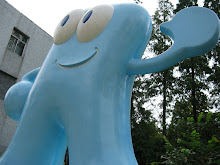
This feeling is currently being conveyed by Haibo, an apparently friendly, sky blue, cartoon spokesman for the Shanghai 2010 International Expo, aka the world’s fair. Within a 50 mile radius of downtown Shanghai, you’re never likely to be more than 100 yards from some kind of Haibo manifestation, his ever waving hand greeting you at every turn, in preparation for an event that doesn’t begin for another 20 months. The expo is expected to generate over 50 million visitors during its five months of existence, which is impossible to comprehend, based on my experiences in the already overcrowded subway stations, continuously brimming at capacity. I don't doubt that Shanghai will be well prepared for their exhibition to the world in 2010, I just hope by that time I'm able to better comprehend this crazy place.

Monday, September 29, 2008

KFC vs. McDonald's vs The Future

China is currently in the midst of a mushrooming epidemic. KFC has been on the offensive, resulting in a grand total of over 1,000 chains across the land, and a new location emerging every other day. Is this attributable to the perceived Southern hospitality of Colonel Sanders? Is it the universal fascination with the state of Kentucky? Or, is it simply the inevitable result of a nation in love with bones? In case you chose, a or b, allow me to illuminate the situation. To eat a boneless piece of meat in China, is to tailgate a Raiders’ game with caviar and wine coolers, while wearing a Broncos jersey. People will question your integrity, and may even interpret your behavior as an attack on their way of life.

The Chinese logic is that the bone possesses a magnetic pull on all the flavor particles contained in a given piece of meat, and therefore, the concept of a chicken breast is nothing more than a bland abomination. It’s no wonder chicken feet are such a popular dining item, as they contain more bones per square inch than any other part of the body. So, it could be argued that KFC’s Chinese success is due entirely to its wide assortment of bone riddled ji rou (chicken).

Despite the fact that KFC is the fast food of choice, the holy grail of American influence lies below the golden arches in the heart of downtown Huzhou. The lone “Mai Don Lao” seems to be the centerpiece of the city, the capitalist bull’s-eye, located in the exact geographic center of the map. It features two fluorescently lit floors, open 24 hours a day, vigilantly watched over by none other than Ronald himself, whose life-size plastic incarnation occupies a permanent seat on the bench at the entrance. In Ronald’s immediate vicinity, opportunities abound for purchasing whatever random item seems appropriate at the given moment. Peddlers of baby turtles battle for position with puppy pushers, who pack their furry merchandise in cages as tightly as a box of cigarettes. In typical downtown fashion, a great wall of scooters surrounds the perimeter.
As if this setting wasn’t confusing enough already, I was further perplexed by stumbling upon a disgusting display of consumerism, that I will admit was equally entertaining. Like the aftermath of a gruesome car accident, I couldn’t bear to watch, but I couldn’t look away either.

A Mai Don Lao employee, decked out in heels and a mini skirt, cordless microphone in hand, was leading a dozen of Huzhou’s most adorable and impressionable knee-high residents through an aerobic workout. Twenty four bright, eager eyes were glued in an upward gaze, awaiting instruction in an improvisational song and dance routine. Parents, and innocent bystanders like myself observed the proceedings, generously applauding the performers. As the class winded down, the instructor led the lemmings, who had obviously worked up a value meal sized appetite, directly past Ronald’s grinning likeness, into the fluorescent Promised Land. There, they were bombarded by larger than life images of Big Mac’s, which will forever be engrained in their psyche as the happy place where you get to dance and eat hamburgers.

China has opened up the floodgates of western influence, and marketing departments everywhere are salivating at the ocean of opportunity that is business in modern China. Unfortunately, the euthanasia may be ripe for the picking for the sole fact that they’re the 2nd generation of the one child policy.

In my attempts to make small talk with people, I often mistakenly ask if they have any brothers or sisters. The answer to this question is always no for anyone born after China's one child policy was implemented in 1979. This generation has been dubbed 'the little emperors' because they are a mass of supposedly spoiled single children. Many of the people I’ve talked to confirm these allegations, with their personal opinions, but not necessarily their behavior. Those little emperors are now having children of their own, which you could call the little Napoleons. A recent amendment to the policy allows couples to have two children, provided they are both single children. Citing mostly economic reasons, many who have been granted this opportunity are passing it up, keeping the one child family alive for at least one more generation. There will now be only one grandchild for every 4 grandparents. Translation; children who will likely be spoiled beyond Mao’s wildest nightmares, and the guaranteed future propagation of KFC and Mai Don Lao.

Monday, September 22, 2008

Don't believe the hype.

Before departing for China, I had an array of concerns and assumptions about my experience to be. Will I be able to breathe? Do babies come out of the womb clutching a pack of cigarettes? Will I be able to walk down the street without being repeatedly spat upon? Are the Chinese familiar with the concept of waiting in line?

Ive now been in China for just over a month, during which time, Ive had a crash course in Chinese culture and customs, providing me with some initial reactions to my preconceived curiosities. What follows is a variety of experiences and observations that have shaped the foundation of my opinion about those questions.

Also, to cleanse your literary palette, Ive interspersed these little Chinese nuggets with some of the entertaining English phrases that keep popping up on clothing everywhere.

*****

Blue skies have been few and far between in my experience thus far, and by few, I literally mean 2 days. This reality led to me being particularly amused by one of my high school student’s response to the question, “What are your favorite activities?” Among other things, she enjoys “looking at the clear blue sky”. The hue of the heavens navigates strictly on a gray scale, which paints a not so pretty picture when combined with the overwhelming humidity.

The air quality compounds my feeling of being on another planet, like I’m in some kind of black and white amphibious, industrial wonderland where the atmosphere is composed of a milky, grey, gelatinous soup, which you can literally feel yourself moving through. Still, somehow the air isn’t as bad as I had actually anticipated, and for a city of its size in China, Huzhou does have relatively clean air. Things could always be worse; for example, my fate could have led me to be located in Beijing. Supposedly, one day of walking and breathing in the capital is equivalent to smoking 70 cigarettes, which leads me to my next topic.

HAVE
A NIKE
DAY!

Fortunately, Chinese babies do not smoke cigarettes, and neither do most young people. There is actually an age requirement to buy them, which is strictly enforced, or maybe Chinese D.A.R.E. has been on a successful crusade to prevent teenage smoking. Lighting up is still much more prevalent here than in the States, but my over exaggerated expectations haven't even been met halfway. The most noteworthy characteristic of smoking in China are the places where it takes place, which is in every imaginable location. This attitude extends far beyond restaurants and bars, and into the uncharted territory of teachers offices, hospitals, and beyond.
I was contemplating joining a gym for the sole purpose of having a place to run where I could breathe freely and deeply without feeling like I'm inside of a coal mine. This pipe dream quickly evaporated when I found out that Chinese men, from time to time, have been known to enjoy a smoke, in the process of running on the treadmill! I guess life is all about balance. For those Chinese folks over the legal age of 18, there are several key attributes which may be utilized to identify smoking potentiality; if you are a male, over 30, or a construction worker. If you, like most construction workers in China, are a male over 30, you will likely have a cigarette permanently dangling from your lower lip like an extra appendage.

IT'S MY SELF
CAMERA
LOVE

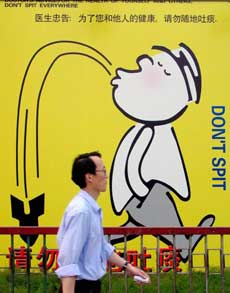
The reality of smoking in China is similar to my interpretation of spitting. Its prevalence has been ludicrously less than I imagined, but its location of occurrence has been it's distinguishing feature. I came in with an irrational fear that I would awaken everyday to the sound of phlegm being cultivated in the throat like an urban rooster’s crow. In reality, my natural alarm clock has been the stampeding of small children, racing towards their congee breakfast (rice porridge). Just as with smoking, I wonder if my arrival came on the heels of a massive countrywide campaign to cut down on the excessive oral removal of the previous day's cigarette remnants.

Among a host of other spitting experiences, the prototype thus far occurred at the Huzhou Police Station, which is where I went to get my residence permit, in case you were wondering. Immediately after turning down the hallway from the main lobby, a senior looking officer emerged from a side room. Before his black boots crossed the threshold of the doorway, a deep, primal sound which I will attempt to transcribe as, HHHUUGGKKT!, emanated from his core, followed by the the transportation of the contents of his mouth onto the tiles of the hallway floor. He casually marched right by me, and in a rare China moment, didn't even do a double take as I walked by.

SUCH A
CRAZY
IDEA!

I have realized an overall pattern, seeping into every aspect of life in China, which relates to a perceived lack of courtesy or patience to the untrained eye. This perception is a simple case of cultural misunderstanding. Chinese people are not intentionally rude or impatient, they just have an unspoken agreement as to how to pursue their desired object or physical space. This rule applies to entering a busy intersection as a driver or a pedestrian. It applies to getting on the bus, boarding a crowded elevator, or checking out of the grocery store.

The universal law of the land is this; whoever can make their way into an unoccupied space first, is entitled to be there. There’s no such concept as cutting someone off because if somebody has enough of a window to squeeze in front of you, then it was there for the taking. In other words, there is no courtesy barrier of personal space. Your personal space extends to the culmination of your hair follicles, then disappears at the border with international waters, where the laws of your home nation no longer apply. Keeping this rule in mind can prevent many feelings of animosity and puzzled amazement and allow you to actually get on to the bus, rather than being passed up by every Chinese person operating under the unspoken agreement.

THE
PARTY'S
OVER!

Tuesday, September 16, 2008

Buddha transcends space and time.

After a mild night of ganbei and pijiu, I woke up at 7am to join Ring, one of my colleagues in the English department at the high school, for what I assumed would be an ordinary visit to her Buddhist temple. We were chauffeured by her father, and after he accidentally put the car in reverse, causing it to violently lurch forward, Ring explained that he is a "new driver." At this point the non-functional seat belt in the backseat quickly escalated on the scale of significance. Ring’s mother and aunt joined the driver's ed session, and we escaped from the city along a dirt road, which winded up into the mountains through fields of green tea and bamboo trees. Our destination was the elaborately decorated facade of a temple, set amongst bamboo saturated mountains and the cleanest air I have thus far inhaled in China. Ring escorted me on a tour of the interior of the temple, which was a barren concrete wasteland, mostly void of decoration. I would shortly find out why this was the case.

Back outside, I joined in the burning of candles and incense, which Ring convinced me to participate in my saying, “When you are in Rome.” While doing my best to do as the Chinese Buddhists do, a demolition squad began smothering the ground around me with fireworks. I wasted no time in relocating to the safe haven of the nearest shelter, just before the commencement of a 20 minute barrage of thunderous explosions, each one giving off the deafening boom of an M-80. Ring explained that they were welcoming the Buddha, which turned out to be much more literal than I assumed. Through the smoke and over the carnage of the perished fireworks, hordes of people made their way down the mountain, towards a trio of open bed trucks, which contained all of the interior decorations for the temple, including 5 gargantuan Buddha statues. What followed was probably one of the craziest moments I have ever witnessed.

To my surprise, a combination of monks, ordinary men, women and children squeezed up against the truck to have the statues transferred onto their outstretched arms. Caving in to my temptation not to let this moment go undocumented, I captured a quick photo of the operation before filing into the Buddha transportation assembly line. The weight of the statue being transferred onto the backs of a crew of moderately sized humans was met with a chorus of grunts and moans and laughter from the observers. Up the muddy hill we marched, with a grandma to my left and a monk in slippers to my right, and a portable cheering section screaming a combination of directions and encouragements along the way. After navigating around several trees and 3 flights of stairs, we delicately delivered the 800 pound statue of His Holiness to what is hopefully His final resting place inside of the temple.

Once all 5 of the Buddha’s were in place, the congregation paid their respects in a lengthy prayer. What followed was a moment that will likely be recurring throughout my trip. My brain navigated through a whirlwind of emotions, trying to comprehend exactly what was taking place. It was another China moment, one in which I wasn’t sure if I’d traveled;

a) back in time,
b) into the future, or
c) to some alternate universe where past and present have collided with fascinating results.

So, here I am in a bamboo forest, in a mist shrouded Buddhist temple, with a trance inducing soundtrack of slow drums and chanting monks who could have easily stepped out of the 12th century. In this same moment, spread before me are a legion of urban Chinese, kneeling on yellow pleather prayer pads, before 3 giant cellophane wrapped Buddhas, while decked out in the latest knock off Versace, and Dolce & Gabbana. Suddenly, the soothing soundtrack is interrupted by an obnoxious Chinese pop song, delivered via the ring tone of a woman bowing before Buddha with a Loius Vutton bag draped around her shoulder, who removes herself from the ceremony to take the phone call. Where and when in the hell am I?

Shortly after, I’m treated to one of the best meals I’ve had in china, a spread of faux meat dishes over rice. Gathered around me are Ring’s family and several others who all insist on shoveling food into my bowl at a slightly faster pace than I’m able to transfer it into my mouth. Just before my bowl begins to overflow, I insist “Wo bao le,” or, “I’m full,” which I try to reserve for the last possible moment. To avoid any unintentional disrespect, I’ve decided to avoid declining any invitations in China unless they’re completely unreasonable. This strategy has put me on the brink of disaster, as I nearly reached the stage of gluttony that results in returning all of the food I was offered, but it’s also the philosophy that led to me going through with the blind massage, and waking up at 7am on a Saturday morning to experience the moving of the Buddha.