Sunday, June 28, 2009

Malaysia

I arrived in Malaysia knowing little about the place and to be honest, I viewed my crossing of the land as little more than a means of getting to Indonesia. As a result, every positive moment and nugget of knowledge gained were unexpected bonuses.

My first destination after crossing the Thailand-Malaysia border was Georgetown, a historic city that may best summarize the diversity of this country. Compromising most of the old town are the neighborhoods of Chinatown and little India, a preview of the rest of the country. Along with the native Malay, these groups seem to intermingle freely and many seem to downplay their original heritage in favor of a Malaysian identity. Malaysia has had its share of race riots, but seeing Indian people buying dim sum from a street vendor next door to Chinese people eating Chicken tandori gives at least a temporary impression of racial harmony. Probably because of its status as a cultural melting pot, Georgetown is known as the food capital of Malaysia, and I had the good fortune of touring the city's culinary highlights under the supervision of some locals, stuffing myself with dishes like char keaow tow, laksa, hokkien mee, cendol, and abc (maybe the strangest - shaved ice with sweet syrup, beans, peanuts, assorted fresh fruit, and ice cream).

By the same good fortune, I was led to a small bar in the backstreets of Chinatown, which sold the cheapest beer in the city (alcohol is taxed to death in Muslim Malaysia - resulting in the cheapest beer costing $1.50 per can, and much nostalgia of 18 cent draft beer in Vietnam.)

A pair of minivan rides through endless palm tree plantations delivered me to Taman Negara, or National Park, the oldest rainforest in the world at 130 million years of age. A variety of trails snake through this leech infested playground of flora and fauna ranging wildly in difficulty. One of the easiest trails leads to a canopy walk, which winds its way around the treetops at heights of up to 40 meters, which isn't very comfortable to know when you're walking on planks of wood and rusty ladders that seem haphazardly tied together with rope.The main attraction here was the opportunity to spend the night in a hide, an extremely basic hut in the middle of the jungle where you can sleep and observe wildlife by night. Getting there required climbing up and down various creek beds in the hottest and most humid air my skin has ever come into contact with. To survive this round trip journey, I traveled with 2.5 liters of water, not nearly enough, but just enough to prevent me from becoming a delirious maniac (explanation to follow). The hide was a modest room with 8 bunk beds and a long bench facing a giant window overlooking a jungle meadow, kind of like an electricity-less plasma screen for neanderthals. Although the park is known for having tigers, elephants, tapirs, and giant snakes, the largest creatures I saw where geckos and rats. Most likely, this was due to the loud ranting of a dehydrated Dutchman who was sharing the sleeping quarters. This guy arrived at the hide in a state of despair, after hiking alone all day and recently running out of water. Still, the 6 hour journey was worthwhile for the sounds alone. As twilight faded into pitch black, a chorus of ticking and purring sounds emanated from the jungle, at a volume that could rival rush hour traffic in any major city. In the middle of the night, the sky erupted in thunder storms and rain pounded on the roof of the hide with all of the occupants fearing that it would likely collapse.

In the process of leaving Taman Negara, one of my most memorable Malaysian experiences took place. Having had very little previous exposure to the Muslim world, images of Muslim women in my mind are severely limited, setting the stage for an entertaining and stereotype smashing moment. On the bus, there was a traditionally dressed Muslim woman collecting fares from the passengers. Her initial appearance and demeanor suggested she must be as rigid and old fashion a woman as you could possibly encounter. Shortly after our journey began, she proved otherwise, as her cell phone erupted, filling the bus with "dont your wish your girlfriend was a freak like me," being her ringtone of choice.

A train ride through more palm tree plantations led to Melaka, another historic town filled with colonial buildings from the days of Portuguese and Dutch occupation. Similar to Georgetown, one activity overrode every other - eating as much food as possible. Eating an average of 5 meals per day allows many opportunities to discover hidden treasures, and in Melaka's Chinatown, I found what I can confidently claim to be the best value meal I've ever consumed, and I mean best value MEAL, not best VALUE MEAL. The dish: Baba Rendang minced fish and prawn noodles - which features all of the mentioned ingredients in a bowl of spicy coconut curry sauce - quite possibly the best combination of flavors ever assembled in one bowl, and the price: $1.15.

On the last day in Melaka I managed to consume 2 servings with room for desert (mango cachang) to spare.The next and final stop was the national capital of KL (Kuala Lumpur). To illustrate my ignorance regarding Malaysia prior to entering, there were only 2 symbols I could associate with the country, one being Will Farrell's portrayal of the prime minister in Zoolander, and 2 being the Petronas towers. The twin towers, as they're referred to locally, are a source of pride for most Malaysians, mostly due to their brief run as the tallest buildings in the world from 1998 to 2004. What i didn't know, is that Petronas is a multinational oil corporation, a lesson learned the hard way in my attempt to visit the catwalk connecting the towers on the 41st floor. Before ascending the high speed elevators which travel an average speed of 1 floor per second, visitors are corralled into a mini cinema and subjected to a 3-D movie (glasses included), of propaganda in its purest form. Imagine traveling dangerously close to the surface of the ocean towards a shimmering oil rig before plunging into the sea and down into the bowels of the earth in 3D! Most of the remaining minutes are spent educating visitors about Petronas' shining record of public service, what an asset they are to the community, how Petronas is more concerned with curing blind street children than profits, and of course how the towers are the most impressive feat of engineering the earth has ever seen. To be fair, the view was not bad and a free 3D movie is hard to come by, even if it brainwashes you to love the smell of gasoline.

Wednesday, May 27, 2009

Southern Thailand

Southern Thailand may simultaneously be the world capital for jaw dropping beaches and equally unbelievable public inebriation. The scenery is filled with dramatic limestone cliffs, covered in jungle growth, bursting through turquoise water and white sand beaches.
In addition to being an epicenter of sunbathing, snorkeling, scubadiving, and parasailing, it's also the land of "the bucket." The bucket is a phenomenon whose name is self explanatory. It's a bucket, which would normally be used by a small child in building the outer towers of a mammoth sand castle, instead filled with some combination of ice, whisky, vodka, coke and red bull. Consuming an entire bucket can lead to seriously impaired judgment, including engaging in dangerous activities in hopes of being rewarded with another bucket- a vicious cycle. Bucket mania reaches its zenith on Phi Phi island, which is advertised as one of the most beautiful islands on earth, and the area of Thailand hardest hit by the tsunami.
The island is filled with beach side bars, which all have plenty of buckets on hand and feature various forms of entertainment involving the use of fire. Most of these spectacles are limited to professional fire juggling locals, but the most entertaining show involved some eager tourists and a giant flaming rope. Two nonchalant Thai teenagers, with cigarettes dangling from their lips, rotated a 25 foot long rope which was heavily soaked in fuel and set ablaze, while an array of tourists lined up to try their luck in the devils jump rope, with a free shot of tequila awaiting the survivors on the other side. About half of the contestants made it through unscathed, while the other half came in contact with the flaming rope and stubbornly attempted the feat over and over again with similar results.

Taking the risk to the next level was tourist Muay Thai, which was strangely located in the 'Reggae bar.' A giant ring was set up in the middle of the bar, surrounded by a bucket sipping audience. Tourists are lured into the ring with the promise of a free bucket if they survive the fight. Between rounds, bar employees parade around the premises with a sign which comforts potential entrants, "Includes protection such as head gear." Most who decide to throw their hat in the ring appeared to have already consumed 1 bucket too many, often times falling over their own feet rather than from the pummeling by their opponent. When the tourists had tired themselves out, 2 locals entered the ring and engaged in one of the most vicious fight I've ever witnessed, ending with the loser being carried out of the ring on a stretcher. Muay Thai is no joke.

May 1 officially marks the start of the low season for tourism in Thailand, and on this day I entered my final Thai beach destination of Ko Lanta. My arrival came in the pitch black of night which meant a difficult search for accommodation on an island that was mostly deserted. As despair was setting in, a loud 'hello' came streaming out of a dimly lit driveway. A lanky figure of about 6'2" came striding out into the light, proclaiming, "I have room for you, 200 baht ($5.60)." Content with the price and the enthusiasm of the sales pitch, I followed him towards the beach for a tour. In the next few days this man would become a legend in my memory of Thailand. Hutchieboat, whose name alone is worthy of legendary status, proudly showed off his beach bungalow complete with mosquito net, fan, mini fridge, hammock and manual flush toilet - which is flushed by manually dumping buckets of water inside. What more could a man ask for in life? After agreeing on a price of 150 baht per night, Hutchieboat retreated to his own bungalow, but wasted little time in displaying his southern hospitality. 2 minutes after handing over the keys, he returned with fresh towels for the bathroom. 5 minutes later he was back again with an extra chair and cushion for the balcony. Another 5 minutes elapsed and he was back again, this time bearing a superior fan which he insisted on exchanging for the one in my bungalow. The next morning he showed no signs of slowing down, knocking on the door at 9am, insisting that I borrow his motorbike to go buy drinks to stock the mini fridge from the local 7-11. Over the next few days Hutchieboat would tell many stories about his life intertwined with the history of the island. These mostly revolved around his work on a nearby rubber tree farm, and the island's 95% Muslim population, to which he belonged. In addition to the hospitality, I became attached to my humble home, which attracted various visitors during my stay. Depending on the hour of the day, the bungalow was inhabited by a colony of ants, a fist sized spider, a frog, who lived behind the toilet for 3 days, and a stray dog who settled into the corner of the balcony.A few days later, I was back in modern reality in Malaysia, which proved to be a mind opening experience, as I entered with no knowledge of the place or what I might experience there.

Saturday, May 23, 2009

The land of a thousand smiles

My arrival in Bangkok coincided with two theoretically opposed events. Most important to the international news media was the violent clash between the military and a group known as the red shirts, who were demanding the resignation of Thailand's prime minister. This led to blazing infernos, street closures, and an intimidating, heavily armed police presence, which included tanks rolling down the streets. Blocks away, but seemingly on another planet were the festivities of the annual Songkran festival, which commemorates the Buddhist new year. Traditionally, the festival featured the light splashing of floral waters to ring in the new year, but in the current Buddhist year of 2552, this has morphed into an all out, countrywide water war. Tourists and locals alike walk the streets heavily armed with high powered hydro weapons capable of killing small mammals. With the city under siege, it was not uncommon to see groups of supersoaker toting civilians standing side by side with m-16 toting military officers, everyone hoping that the latter wasn't as trigger happy as the former.

The streets were awash with entrepreneurs, cleverly marketing a combination of weaponry and beverages. The most creative would bottle the recently melted ice, which had been cooling the drinks, and sell it to evil minded party goers, myself included, who loved to watch the exacerbated facial expressions of people getting a high powered shot of ice cold water in the spine. Groups of kids congregated curbside around 50 gallon drums of water, which were perpetually refilled with nearby hoses. The majority of the vehicles who entered the area were on-duty moto and tuk tuk drivers attempting to pick up passengers and escort them out of the war zone. These unfortunate souls were the most heavily victimized, receiving violently thrown buckets of water in the face at each passing of a roadside mob of children. Meanwhile, roving bands of teenagers circled the streets in pickup trucks, the beds of which were equipped with their own 50 gallon drums of water, and a team of drive by artists who returned the onslaught of those on the sidewalk.

Adding to the madness was the tradition of smearing baby powder or similar substances on the faces of each passerby as a sign of respect and new years luck. With a population soaked to the bone, this quickly morphs into a citywide paper mache project, as everyone acquires a layer of crusty body armor, which is then washed away by high pressure water blasts and replaced again and again. By midday, the epicenter of the water fighting looks like it was infested with zombies or struck by an atomic bomb, with dusty victims strangely skipping around in the aftermath.

Providing refuge from the madness was an impressive lineup of cultural venues to remind people that the festival was a celebration of Thai culture, not just the opportunity to shoot your neighbor in the face. There was lively Thai theater, and a vivid puppet show reminiscent of being john malcovic, but the highlight was a b-boy performance to the soundtrack of traditional drumming.

Over the days, I found myself continuously under armed against kids the size of my thigh, whose guns were of equal size. The most memorable experience came on the final night, while wandering the many soi (alleyway) of the old town of Bangkok. After being viciously bombarded with water that would have solidified had it been any colder, I was invited to join the party of the perpetrators, a family of Nepalese shop owners. They had set up a sound system worthy of a night club in front of their corner store, blasting Nepalese and Indian dance music while dousing each passerby with a liberal amount of specially formulated ice water. I quickly realized that their store was conveniently located next door to an ice factory which resulted in the continuous addition of newborn-baby-sized blocks of ice into their bucket. There was never a moment when the bucket consisted of more water than ice.

When it was all said and done, Songkran (click link for video coverage), was one of the most memorable festivals I've ever experienced. What better way to build community than to shoot your neighbor in the eye with ice cold water during the hottest month of the year? Peoples expectations of personal space and liability issues would likely prevent this event from taking place in the U.S., which is a shame.

After an overnight train from Bangkok, which was invaded by an army of baby cockroaches, I touched down in Chiang Mai, which is known as the cultural capital of Thailand - due to an insane amount of elaborate Buddhist temples. For one week, I explored the city by motorbike, and driving on the left hand side of the road proved to be a continuous challenge. The celebration of Buddhist new years was still in full effect, and while wandering through Wat Don Suap, I was invited to partake in a continuation of the water splashing ceremony, this time much more traditional than in Bangkok. Following the lead of the young children ahead of me, I was given a tub of floral water and instructed to proceed on my knees. Shuffling along in a line, we made our pilgrimage, passing a line of seated elders, each of whom would take a handful from our bucket and gently pat us on the shoulders. Those who spoke English curiously asked me where I was from and wished me luck in the new year. Those who didn't speak English, whispered to their neighbors, probably inquiring about where I was from. At the end of the line, I felt like I had gone on a hajj, and realized that my youth is fading, as my knees were decimated from a mere 15 minutes of shuffling against the carpet of the temple.

At Wat Umong, I found my way into an area labeled as the monastery zoo, which featured a herd of some kind of deer-cow hybrid looking creature which the monks cared for. Upon entering their living space, I found the monks preparing to feed them with some kind of eggplant- cucumber looking hybrid of vegetable. While cautiously keeping an eye on one of the beasts who the lead monk described as 'crazy,' I joined in tossing the food to the animals and watched them corral them into their mouths with their snake like tongues. The crazy member of the group kept his focus on the strange farang (foreigner) at all times, often flaring his nostrils and stomping his feet - much to the delight of the monks.
From the cultural capital of the nation, a one hour flight south to Phuket quickly delivered me to an entirely different kind of atmosphere...

Saturday, April 25, 2009

Goodbye Vietnam

Throughout Vietnam, there is one man who is revered and respected on a level which surpasses even that of Ronald McDonald. Nowhere else is this more apparent than the National capital of Hanoi, the final resting place of Ho Chi Minh, or Uncle Ho, as he is lovingly referred to by the populous. Uncle Ho's smiling face appears everywhere in Vietnam, on every single bank note of every denomination, on countless propaganda posters, and above the entrance to nearly every school. Not surprisingly, his mausoleum is a mecca for supporters, traveling from far and wide to pay their respects. Following in the communist footsteps of Mao and Lenin, Uncle Ho's 'actual body' is supposedly preserved in a clear glass case, and annually shipped to Russia- the world leader in 'keeping dead people looking alive' technology. Viewing the body is a surreal experience, more for the formal procedures undergone before entering the mausoleum, than actually getting a glimpse of Uncle Ho. A strict dress code is in full effect, part of a long list of strange, liberty infringing rules like no hats, no putting your hands in your pockets, and no improper behavior like smiling or talking. Along the red carpeted path to the body, heavily armed guards stand at every turn, some remaining statuesque, others patrolling the crowd and barking instructions for proper conduct to rule breakers - "hands at your sides!" Rumors abound as to whether or not this is really the body of Uncle Ho or a wax replica. I have my doubts.

Hanoi's famous old quarter is where all of the tourists are concentrated, coming to explore streets named after the goods that were once sold there. For example, fried fish street, metal pipe street, and tombstone alley, which these days are more likely inhabited by bootleg shoes, purses, and stuffed animals. These 2 square miles may be the least walkable urban area on earth and its narrow passages are demonstrative of a nationwide phenomenon - a complete and utter lack of personal space. Buildings are so small and packed to the brim that living rooms, workshops, kitchens and basically anything which can be moved outside, spills out onto the sidewalk during business hours. On the one hand, it's entertaining to walk down the street and essentially get to see through the walls and catch a glimpse of all the day to day activities that would be kept behind closed doors elsewhere. On the other hand, having your leg hairs singed by sparks being spewed onto the street by soldering irons and ducking garbage bags tossed from second story windows can begin to take its toll on your sanity.

Shortly after arriving in Hanoi, my dad and i departed to Vietnam's top tourist attraction, Halong bay, which before the WFC, was receiving 7 million annual visitors. The famed bay is filled with dramatic limestone cliffs jumping out of the bay, and insane amounts of tourist filled vessels navigating around them. At its best, the scenery is breathtaking and fully worthy of all the hype and all the visitors, but the downside is an almost absolute lack of environmental awareness, manifested in an alarming amount of liter. The most disturbing moment came on a kayaking excursion, which was quite enjoyable until i paddled directly past a used baby diaper bobbing aimlessly in the water. In the end, the cruise of the bay was an enjoyable experience, but I hope that enough swift action is taken to prevent it from evaporating into a wasteland of used Huggies.

On the same day we returned to Hanoi from Halong bay, we boarded another sleeper train, heading 10 hours north to the Vietnam-China border. Upon arrival in the town of Sapa, we were bombarded by local village women selling handicrafts, a theme that would be recurring. All of these women speak incredibly good English which they attribute solely to tourist exposure, pretty impressive considering many of them have never been to school for a day in their lives. Shortly after arriving, we embarked upon the top tourist attraction in Sapa, a village stay, in which you trek to a local village and sleep with an adoptive family for the night.

Our guide was a 17 year old girl named Moo, who comes from a village of Black Hmong - named for their black clothing, which Moo has given up for jeans and a t-shirt. On the first day of our tour we headed over several terraced mountains and ended up in a small village where we met our family for the night. During the trek, I wondered if staying in a village would be an outhouse and no electricity kind of experience, but it quickly became apparent that our host family has done quite well for themselves in the village stay business. Their massive two story house featured concrete floors, satellite tv, dvd player, western toilet, pool table, cold beer, and hot water shower - complete with images of naked girls printed on the bathroom tiles. Not exactly roughin it. The highlight of our stay was a delicious home cooked dinner, which was shared at the table of our hosts. The father insisted on alternating spoonfuls of rice with shots of rice wine with me for the duration of the meal, while the rest of the family was transfixed on the tv, watching Chinese soap operas poorly dubbed in Vietnamese.

The low point of the trek came en route to our second village stay. Along the way, we were followed by a pair of seemingly friendly women, but once we reached the midpoint of our journey, their intentions became clear as day. A slew of sales pitches commenced, with a different response for every polite 'no thank you.' These pleas escalated dramatically in desperation from 'this bag is very pretty' to "you buy something and i stop following you,' and culminating in one of the women revealing a bag of weed from her hand woven purse hoping that she must have something i would be interested in buying. After this unfortunate interchange, (i didn't buy anything), we crossed through a massive construction site which was eating away at the mountain, making way for a huge hydroelectric dam. Not only is this an environmental disaster in the making, its also incredibly stupid to destroy one of the top tourist destinations in the country. Finally, in a cruel twist of fate, our neighbors at our second night's homestay turned out to be a huge group of Dutch tourists who spent their evening butchering Beatles classics on their host families blaring karaoke system. Hey Jude will never be the same.

My last destination in Vietnam was the laid back town of Ninh Binh, which is surrounded by rice paddies and limestone mountains. My visit fortuitously coincided with the annual Truong yen festival, which commemorates a pair of 9-10th century Emperors. The festivities were wide ranging, some being more traditional than others. I first wandered past a relatively tame cock fight, which was easier to digest after countless sleepless nights thanks to rogue roosters. To relax after this hard hitting action, i sat down to observe a life size game of Chinese chess, which can already take hours to complete, compounded by the time taken for each player to walk across the board and move his desired piece. This game is played everywhere in China and Vietnam, usually with a group of 10-15 old men huddled around the board advising the opponents on their next moves, as was the case in this life size battle. The most entertaining event of the festival was a traditional wrestling competition, in which participants sported sumo like cloths over their shorts and engaged in a ritualistic dance before doing battle. Through body language, everyone in my vicinity in the audience tried to coax me into the ring to challenge the champion. Tempting as the offer was, im pretty sure getting my collar bone broken by a Vietnamese dude with the physique of a pit bull isn't covered in my insurance policy. So, with my health still intact, I made my exodus from Vietnam to the Land of a Thousand Smiles.

Saturday, April 4, 2009

Central Vietnam

After an overnight bus ride from hell, my dad and i were deposited on the quiet streets of Hoi An at 5am. The city was the largest harbor in Southeast Asia in the 1st Century, and its contemporary claim to fame is its surviving old town, a UNESCO heritage site which features some of the most walkable streets in Vietnam. There's an occasionally enforced ban on motor vehicles (the sign specifically forbids any "non primitive vehicles"), and the streets are lined with well preserved buildings that have been converted into a tourist shopping haven, selling tailor made suits, buddha statues, modern art, and chinese lanterns. The highlight of our 48 hour stay ended up being cruising around the nearby countryside by bike. Under the protection of an overcast sky, we rode through villages surrounded by rice paddies, grazing water buffalo, and handfuls of enthusiastic children screaming hello. One such journey brought us to what appeared to be a scam perpetrated against foreigners. Within sight of the local beach, we were stopped by a pair of locals, who calmly explained that we had to leave our bikes in the 'official' parking area, which cost 12 cents. We reluctantly handed over 4,000 dong and made for the beach. Upon returning and retrieving our bikes, we were treated to an unexpected performance displaying the musical prowess of our bike guardian, which left us feeling like we got our moneys worth. To the background music of a Vietnamese pop song, bike man sang a passionate, improvised ballad, and in the process, insisted on taking my hand and leading me through a dance routine. "I watch your bike, you no worry. I watch your bike, your bike ok with me!" He continued in similar fashion for the duration of the song, and bid us farewell with a dramatic bow.

A four hour bus ride north delivered us to the imperial city of Hue, (pronounced Way), which was the capital of Vietnam as recently as 1945. The city was crushed during the war, and only recently have its many historical landmarks begun to be reconstructed. Based on the following experiences, this ended up being my favorite place in Vietnam. On the night of our arrival, we stumbled upon a gem of free entertainment - a high school dance competition in a park overlooking the Huong River. Hip hop appears to be alive and well in Vietnam, as group after group put together some impressive breakdancing performances, some more creative than others. The standouts were one crew that played air guitar with traditional Vietnamese instruments and another that danced to a Vietnamese remix of the Beverly Hills Cop theme song. The only low point of the night was a mass ensemble of about 25 kids performing a routine to the theme song from high school musical. That aint hip hop.


Again, a major highlight here was exploring the nearby countryside by bicycle, the most entertaining journey being a quest to locate one of two existing Japanese covered bridges in Vietnam. After asking a handful of eagerly helpful locals for directions, we eventually got ourselves in the vicinity of the bridge, and then found it by dumb luck, as a woman vendor flagged us down to come have a beer. We caved in to her sales pitch, only to find that her snack stand was located in the shadows of our desired location. Upon entering the shelter of the bridge, we were met by an intriguing character, an old woman with painted on eye brows, and bare feet exposing freshly painted, bright red toenails. She spoke excellent English which she attributed to her past marriage to an American soldier. After our initial introductions were complete, she proceeded to inform us as to why she was occupying the bridge; to tell the fortunes of those who pass. For shits and giggles, we both presented her with open palms, which resulted in some mind blowing revelations. First for the father: "You very good man, you very good to your family, very handsome, you have good son, love you very much." Then for the son: "You very handsome. Your family love you very much. You very good boy. Good to your father. Very nice boy." Then the most important news, she forecast that our deaths would come at the respectively ripe ages of 88 and 82.
From one interesting character to another. Just beyond the bridge, we reached the village museum, whose sole employee was an unforgettable old woman in her pajamas, who guided us through the most entertaining museum tour on the face of the earth. The museum housed a small collection of traditional Vietnamese farming equipment, which the woman who was well into her 80's, proceeded to passionately demonstrate one at a time. With the energy of a small child, she jumped from one piece of equipment to the next, violently stirring the rice grinder and pedaling the bicycle-like water distributor, adding to the drama with an impressive array of sound effects, such as the chopping of the rice plants, crying babies, and water buffalo splashing through the mud. All the while, she sported a friendly smile, exposing teeth that appeared to be intentionally blackened. After a failed, modest sales pitch for us to buy some water buffalo figurines from the dusty gift shop, she graciously accepted a small donation to the museum and waved goodbye before going back to sleep on the table at the entrance.
Hue also became the place where we would get our most insightful look at the day to day lives of some typical Vietnamese folks. Through the wonders of the Internet, i was able to get in contact with Thuan, a local university student, who agreed to meet us for the prototypical social gathering, drinking coffee. After a night of getting caffienated by the city lake, which he and his friend described as lover's lake (for all of the couples who frequent it), he invited us for lunch in his apartment, which is shared with his younger brother and friend. We arrived at his abode to find that these 3 guys share one 6' x 10' room with one bed and one desk, which immediately made me fell like a spoiled idiot for ever having issues with the amount of personal space afforded by the dorm rooms of California. His roommate prepared us a delicious lunch, which we shared on their bedroom floor, regularly interrupted with a rotating shot glass of rice wine,(their drink of choice because of its combined potency and affordability - 30% alcohol and 42 cents for a .5 liter bottle). After our meal, the landlord, a 92 year old man known as Uncle Le, crashed the party. Uncle Le didn't speak any English but seemed fascinated by the presence of the 2 strange foreign visitors, an ear to ear smile glued to his face for the duration of our stay. Through the students' translation, Uncle Le made several attempts to set me up with one of his many granddaughters. Lunch officially ended with a photo shoot of the students and Uncle Le, who burst into uncontrollable laughter every time we showed him the freshly captured images on the screen of my camera.
The following afternoon, we boarded a hard sleeper train, (named for the 1cm thick mattress we slept on). We quickly crossed through the former demilitarized zone (DMZ), which separated north and south Vietnam in the not so distant past. 15 hours later, we were stumbling out into the madness of morning rush hour traffic in the capital city of Hanoi...
Sunday, March 29, 2009

Southern 'Nam

Arriving in Ho Chi Minh City, aka Saigon, was a dramatic return to the developed world. For the first time since China, my field of vision was cluttered with high rise buildings and neon lights as far as the eye can see, a strange twist of communist fate. Within hours of arrival i realized that i had died and been sent in the opposite direction of hell. Pho for $1, Vietnamese sandwiches for 60 cents, the strongest coffee known to man for 30 cents, and draft beer for 18 cents. Needless to say, i treated HCMC as my personal buffet, and most of my waking hours there were spent stuffing my face.

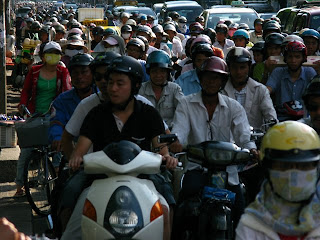
5 months in China trained me well for what would otherwise be a difficult vietnamese venture, parting the sea of motorbikes and crossing the street. Here, rush hour is a term that applies from 6am to 11pm, as the streets are consistently packed with masses of 2 wheeled vehicles. Getting to the promised land, the other side of the street, requires blind faith and cat like reflexes. Maybe the biggest motivating factor to cross through the madness was witnessing several blind people parting the sea unassisted!
HCMC was also the fated location for me to be reunited with my dad, who would join me on a nearly 1,000 mile journey up the Vietnamese coast, to within reach of the Chinese border.
One of the most bizarre and memorable, yet least recommendable experiences of our trip was an organized tour of the Cu Chi tunnels, a complex underground network of manmade caves which were occupied for a mind blowing 17 years by the local Vietnamese, who were escaping American troops. (On this side of the Pacific, the war is referred to as the American war.) Our guide, who introduced himself as Mr Bean (Binh), was a soldier for the South Vietnamese fighting alongside the Americans. Over the course of the next 5 hours he proved to be an unforgettable character.

During our 2 hour bus ride Mr Bean sped through as much Vietnamese history as possible, with his own life story intertwined. He reminisced about his time living in New York, which is where he likely acquired his colorful vocabulary. "Lonely planet is bullshit book!" he proclaimed. "i tell you the real history of Vietnam!" He then illuminated the group on one thousand years of various occupations of his homeland, first by the Chinese, then the french, then the Americans and later by the Khmer Rouge. During his passionate, rapid fire presentation, many questions arose, one in particular from a German tourist who was having trouble understanding Mr Bean's new york accent. "Why Vietnam was divided into north and the south?" Mr. Bean explained "its complicated, (under)'stand?" and moved right along with his presentation. During our journey, Mr Bean made many a questionable claim, including knowing who killed JFK - obviously he couldn't reveal the details.
We eventually reached our destination of the Cu Chi tunnels which proved to be a strange and disturbing place. The site has been converted into a guerrilla warfare amusement park, featuring replicas of painful booby traps used against the Americans, along with robotic Vietcong, who with the flick of a switch, kick into gear and simulate the creation of handmade weapons and uniforms. Along the way, Mr bean unveiled the mystery as to why westerners are unable to sit in the famous Asian squat: "because you sit on lazy toilet!" To be fair, he also explained why Asian people have small eyes: "When you eat rice with lot of chili, make you shit like this (He squeezes his eyes shut with all his might).
The midpoint of the tour was the infamous shooting range. Here, tourists can live out their wildest, violent fantasies and fire AK 47's and M-16's into the Vietnamese hillside, for $1-$1.25 per bullet, with a minimum investment of one clip, (a fee that can become hefty when dealing with automatic weapons). Not surprisingly, most of the tour members who partook in this event were in my age and gender brackets. Everyone else took shelter in the nearby gift shop, covering their ears, as the sounds of massive explosions blended with the screams of frightened children.

The tour concluded with Mr. bean, beer in hand, leading us into the feature presentation of the tour, the chance to actually travel through the cu chi tunnels. He reassured us that the tunnels had been widened in order to accommodate westerners, otherwise " your fat ass get stuck in the tunnel!" Our entire busload of lemmings descended into the tunnels and attempted to travel a modest 100 meters undergound. After about 10 meters of nearly crawling on hands and knees in the musty dark, stuck behind a traffic jam of oversized tourists, i nearly suffered a debilitating panic attack from the resulting claustrophobia. For a variety of reasons, i was relieved when the tour ended. The take home message: you have to respect the resiliency of the Vietnamese to live in such cramped conditions for 17 years. I would not recommend this tour to anyone, but if you do get a chance to have a conversation with Mr Bean, you should hop on that train. I'll now conlcude this story in the same fashion that Mr Bean ended his tour. "Thank you. Hope you have good time. God bless you. Hallelujah!"
******

From the sweltering heat of HCMC, me and pops escaped to the mountainous town of Dalat,which the french referred to as the vietnamese alps, for its cool climate and green hills. Here, we relished the opportunity to wear long sleeve shirts and sleep with blankets. One of the primary tourist attractions in Dalat is rightfully known as "The crazy house." It's a bizzare museum/ hotel, designded by a woman whose father was a high ranking member of the communist party. Her special family ties are what granted her the authority to build such an extravagant, "crazy," and non communist building, something I never imagined would exist in Vietnam. The architecture is Alice and wonderland meets Antoni Gaudi, with giraffes, giant spiders, and stairs that resemble congo drums. It really is a crazy house.
Most of the other crazy fun to be had in Dalat is on the outskirts of town, reachable by bicycle or motorbike. For some strange reason, Dalat seems to be the tandem bike capital of Vietnam, so much so that finding a normal bike is close to impossible. A common sight in town is a mob of young vietnamese tourists racing each other through the streets on these 4 pedal vehicles of mayhem. After a fruitless hour attemting to procure traditional rental bikes, and even attempting and failing to use a tandem bike, we relunctantly rented a motorbike for the day, which ended up being $3, half the price of a tandem bike.

We managed to safely escape from city limits and reached the Datanla waterfalls, which seems to have developed into a major tourist attraction in the area. Upon entering the site, visitors are presented with a fork in the road; a) a steep trail of steps leading down through the rainforest, or b) a roller coaster that seems to be made primarily of bamboo. Being reluctant to be the guinea pigs of this experiment, we chose a), but after witnissing handfulls of other more adventurous (or lazy) tourists zoom by, we returned to the top and chose b - and lived to tell about it. At the bottom of the path, Datanla falls carves through the rocks and is surrounded by more tourist gimmicks. Vietnamese cowboys and a lonley guy in a bear suit wait idly for trourists to have their pictures taken with them. Luckily, we saw a tourist have his picture taken with his head inside of the bears mouth, so his suffering through the midday heat inside of such a torturous costume did not go unrewarded.

After a few days relaxing in Dalat, we embarked upon an insane 20 hour bus journey North, to the city of Hoi An...

Thursday, March 5, 2009

Cambodge

My two week stint in Cambodia was a continuos battle against my own ignorance and a journey to nearly every point on the spectrum of human emotion. I bounced from my traumatizing, aforementioned entry to Siem Reap, to the splendor of Ankor Wat, time traveling in Battambang, the depressing legacy of the Khmer Rouge in Phnom Pehn, to the tranquility of the beaches in Sihanoukville.

Despite drowning in a hellish inferno for most of its recent history, Cambodia is a surprisingly upbeat place. Everywhere, examples of the incredible spirit of the people are present. Never before have I seen such a fierce determination to survive. Never before have I seen so many people and/or goods loaded onto a single vehicle. A man weaves through traffic on a byciyle while delicatley balancing a washing machine on his back. A motorbike rides by with a female passenger holding her own I.V. above her head. This is Cambodia.

The legacy of continuous war and genocide has birthed overwhelming poverty here, but somehow the Cambodian people manage to be some of the nicest folks ive ever encountered. But because of the poverty, its no surprise that nearly everyone who approaches you in the major tourist areas is trying to sell something. These pitches range from "Sir, you need tuk tuk?, Ms. you want moto ride?, Mr. you wanna buy book?, Madame you need guest house?, my friend smoke - marijuana - opium?," or my personal favorite, the vague "Mr. buy something from me." This can be overwhelming at times, but the more you know about this place, the more tolerant you become of such bombardments.

After recovering from my nightmare of a transition from Laos, I finally felt at ease in Siem Reap, within a few miles of the temples of Ankar. My first ignorance shattering moment arrived in the form of early morning prayer, emanating from the local mosque, which happened to be located almost directly behind my guest house. My ignorance as to any kind of muslim population in cambodia was left demolished by virtue of this scene being replicated in 4 of the 5 places I visited here. My next ignorance shattering moment came in 3 days of touring the temples of Ankar. Previous to this trip, I only knew of the existence of Ankor wat, the famed temple that appears on Cambodias flag, national beer and countless paintings and t-shirts. Turns out that this is just one of many temples - the entire surrounding area is saturated with some of the most elaborate and intricately designed buildings the world has ever seen. Touring these massive ruins felt like an archaeological Disneyland for grown ups, because of the huge amounts of tourists, all being shuttled from temple to temple in tuk tuks (myself included). While wandering these complexes in nearly unbearable heat, I couldnt help but wonder about the man hours required to build them and the god complexes of those who ordered them built. Either way, you cant help but be blown away by the imagination of the human brain.

Since leaving my latest hometown of Huzhou, China, ive felt myself being pulled deeper into an increasingly narrow funnel of a tourist trail, which has deeply disturbed me. Being able to make even the slightest detour from the flock of sheep came to be of the utmost importance in the maintenence of my sanity. This detour came in Battambang, which is Cambodia's 2nd biggest city, but not a major stopping point on the tourist trail. There's still a noticeable tourist population here, but the town isnt dependent on tourist $, so as a result, its easier to feel invisible and avoid all the sales pitches of other locations. Maybe the highlight of my time spent in Cambodia, was 2 days of journeying out into Battambangs surrounding villages by motorbike.

As an introduction to this story, ill let it be known that my first, and only previous attempt to ride a motorbike nearly ended with me plunging into the tepid waters of lake Titicaca on the Peru - Bolivia border, but that's another story. So, on day one of village exploration, im handed the keys to a spiffy little 2 wheeler with a whopping 125cc! (less powert than most lawn mowers). As im strapping on my helmet, the trustworthy and maybe naive local who is lending me his prized possession asks me if i know how to drive it, to which i reply "kind of," . A nervous paranoia overcomes this mans face, and he begins to carefully explain the instructions of changing gears, using the brakes, etc. He takes me onto a backstreet for a test drive, while he sits behind me, an experience that im sure was not confidence building. After making it explicitly clear that I would be financially responsible for any damage caused ("you brake bike you pay"), he approved the rental and the real test began.

Getting out of downtown battambang proved to be an intimidating experience despite the fact that the city feels like a large village. Still, even a village can be intimidating when there are no stop signs or traffic lights, and vehicles travel on whichever side of the road is most convenient. So, after a nerve wrecking 15 minutes of learning how to change gears and use the brakes, while dodging oncoming traffic, i made it onto a straight dirt road which signaled the end of the madness. For the rest of the day I was cruising past random villages, whose populations all seemed to be comprised of 70% primary school children, who all screamed "hello" as i passed - with no sales pitches to follow. Being here was the kind of experience I came searching for on this trip - to feel transported to a simpler place and time. I imagine that life in these villages hasn't changed much in my lifetime - except for the occasional cell phone.

The rock bottom on the spectrum of human emotions came in the capital city of Phnom Penh, touring sites that have seen some terrible days. I did enjoy my stay here, but because of its history, it wasnt the most uplifting place to visit. Most depressing was a visit to S-21, a high school turned not-so-secret prison operated by the Khmer rouge, which systematically tortured and killed over 20,000 people in the late 1970's. Ive never felt such a negative energy in any place ive ever been. On a less severe but still depressing topic, my guest house, again in the shadow of a mosque, was near the shores of Boeng Kak, the largest lake in the city. When asking a guest house employee as to why there was a crane operating on a patch of sand at the south end of the lake, i learned that it's being filled in to make way for high rise buildings. So what you see will not exist one year from now.
My cambodian experience ended on a natural high in the beach town of Sihanoukville, named after the king. Stepping foot into the ocean after a 7 month absence felt like I had just completed a pilgrimage from the frozen tundra of China. For 48 hours, i kicked back under a beach umbrella, to the soundtrack of waves coming in from the gulf of Thailand. Being another tourist town, the soundtrack was interrupted by sales pitches for bbq'd seafood, bracelets, pedicures and massages. The temptation of an hour long massage on the beach proved to be too great to pass up for a mere $6. This ultimately proved to be a wise investment, but there were times of doubt, as i parted ways with my outermost later of skin due to the strong sandy hands of my masseur, who i think was pregnant. The last night in paradise began with some of the freshest seafood ive ever tasted and concluded with a natural light show unlike anything ive ever witnissed. Shortly after de-shelling my last grilled prawn, the sky behind me erupted in a silent flash of light. Over the course of the next hour, lightning illuminated a sky full of ominous and otherwise invisible cloud formations. Like most good things, this cant really be conveyed in pictures or words, but here's a video i managed to catch.


48 Hours later I was in food heaven in the chaos of Ho Chi Minh City, Vietnam...